
The Reliability Revolution dismantles the outdated belief that wires equal reliability and shows why intelligence-orchestrated, wireless-first networks now determine whether modern businesses stay online or fall behind.
The biggest threat to network reliability today isn’t outages; it’s clinging to assumptions that no longer align with how the business actually operates.
For most of networking history, reliability meant certainty. And certainty came from what you could see. Cables in conduits. Fiber in the ground. Equipment in racks. If something went wrong, there was usually a physical explanation and a physical fix.
That model worked because networks were predictable. Applications stayed in one place. Employees worked from offices. Devices didn’t move very far, very often. In that environment, hardwiring reliability made sense.

Today’s networks support distributed teams, cloud-based applications, mobile devices, and customer experiences that must remain uninterrupted regardless of location or conditions. Reliability is no longer about preventing change. It’s about responding to it without disruption.
Still, one fear continues to shape network decisions:
Today’s networks support distributed teams, cloud-based applications, mobile devices, and customer experiences that must remain uninterrupted regardless of location or conditions. Reliability is no longer about preventing change. It’s about responding to it without disruption.
Still, one fear continues to shape network decisions:
Greg Davis, CEO of Bigleaf Networks, has seen this evolution play out repeatedly in real environments. As he explains, “Traditionally, wireless was thought of as a backup solution. But as we transitioned into 5G, it’s becoming a supplement, and even an alternative, for wireline. Customers are relying on it for business-critical applications.”

Reliability isn’t about choosing wired or wireless; it’s about orchestrating both through an intelligent and automated network.
Reliability no longer lives in the physical connection; it lives in the intelligent layer that continuously optimizes every path.
Wireless isn’t replacing wired.
It’s what makes Wired resilient at scale.
This ebook unpacks that shift and clearly and practically shows why wireless is now essential to reliable network design.
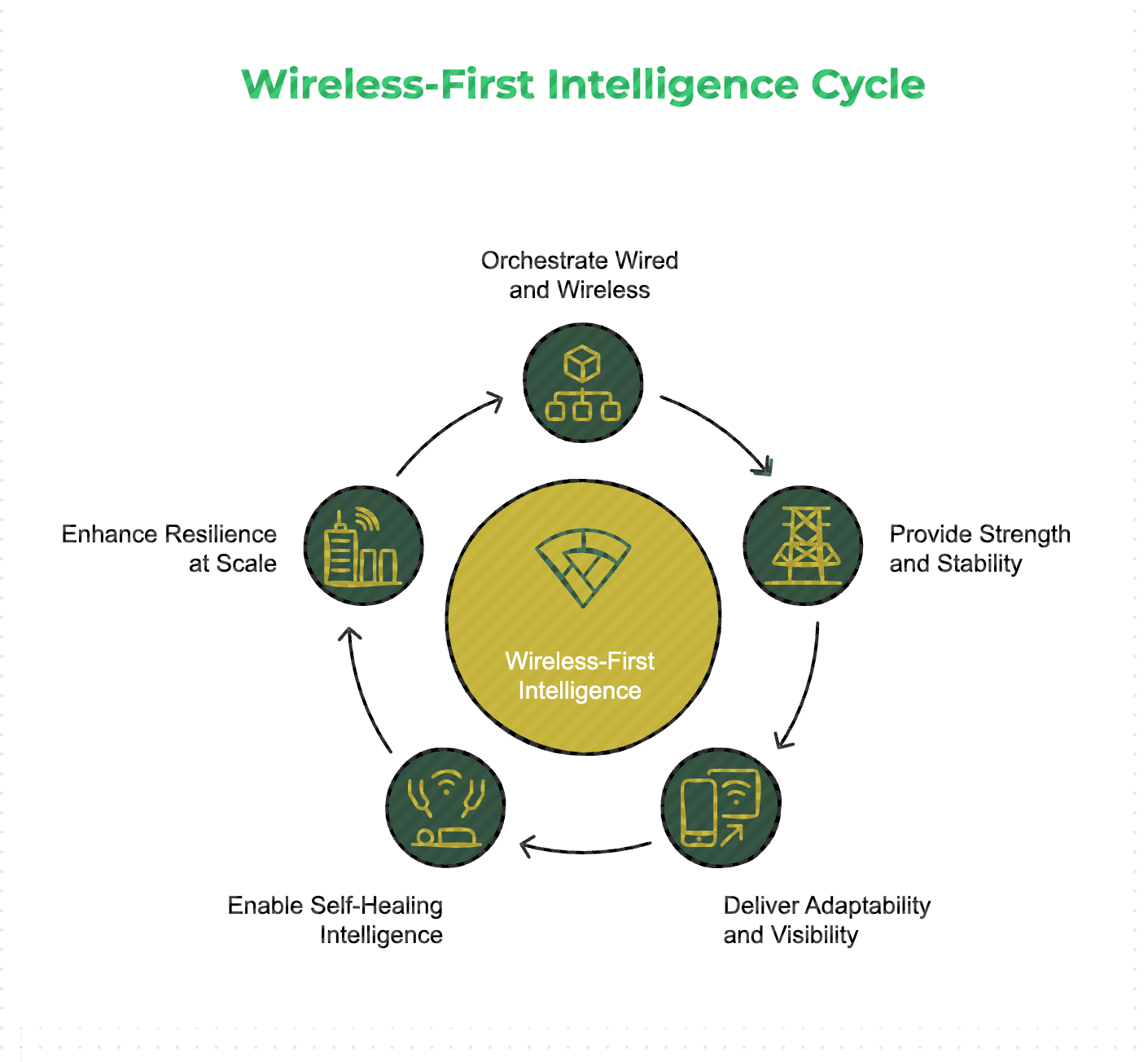
Reliability isn’t about choosing wired or wireless; it’s about orchestrating both through an intelligent and automated network.
Reliability no longer lives in the physical connection; it lives in the intelligent layer that continuously optimizes every path.
Wireless isn’t replacing wired.
It’s what makes Wired resilient at scale.
This ebook unpacks that shift and clearly and practically shows why wireless is now essential to reliable network design.